Living shorelines
Protect your shoreline with marsh, sand and stone
If your shoreline is eroding, a bulkhead isn’t the only answer, and in Virginia it is often not the first one the state will consider. This guide explains what a living shoreline is, when it works and when it doesn’t, how permits treat it, and where to find help paying for one.
1. What a living shoreline is
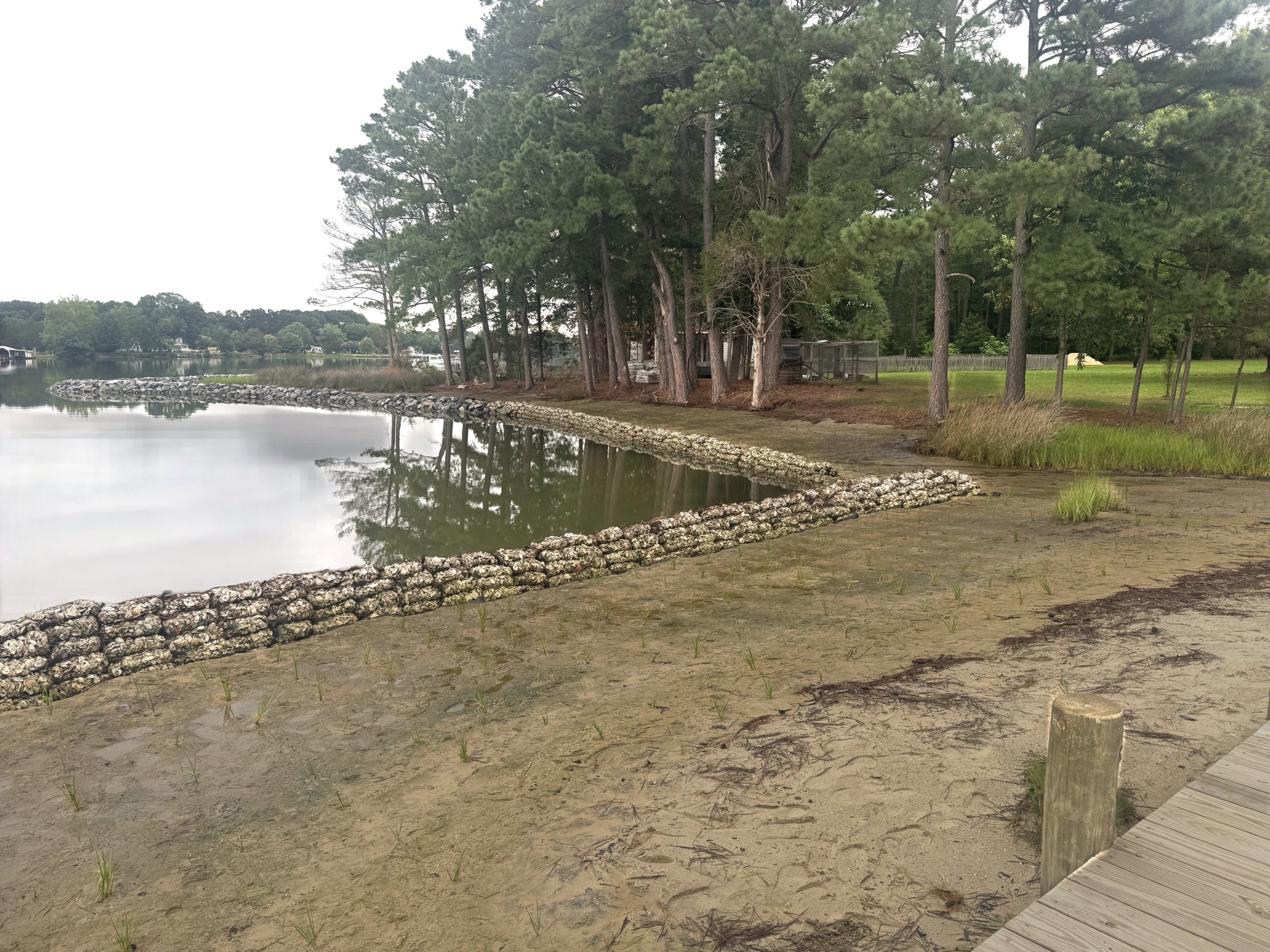
A living shoreline controls erosion with natural materials, such as marsh grasses, sand and stone, instead of a wall. It protects your land while keeping a natural edge where the water meets the shore. Common types include:
- Marsh planting: marsh grasses planted along the shore, sometimes with sand added and the bank graded to a gentler slope.
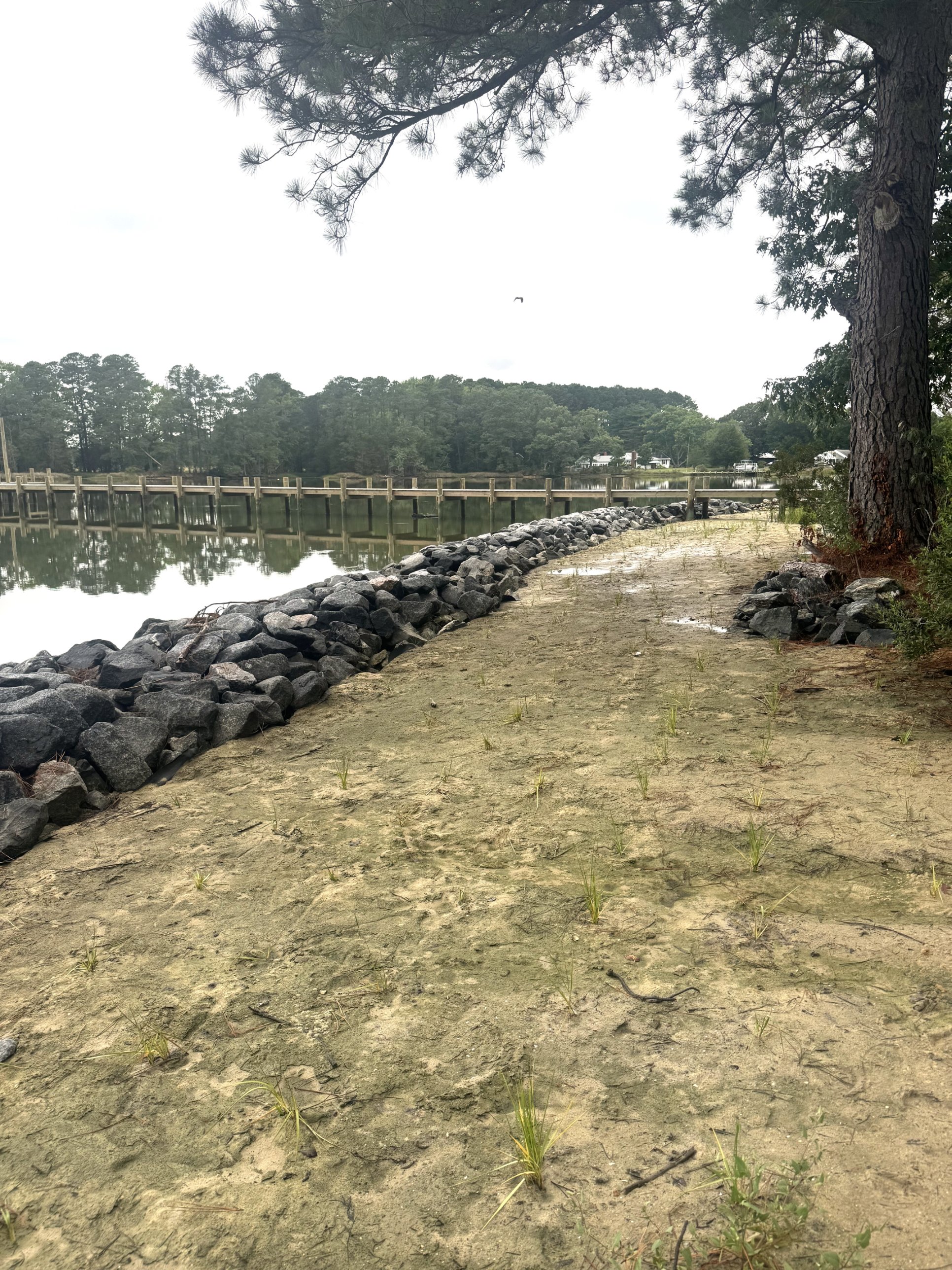
- Stone sill with marsh: a low line of stone just offshore that breaks the waves, with sand and marsh grasses behind it. This is the most common type on more exposed sites.
- Oyster reefs, oyster bags or oyster castles: used in place of stone where the water and bottom are right for oysters.
- Marsh toe sill: a small, low line of stone along the edge of existing marsh, for places where the marsh is already there but its edge is wearing away.
- Coir logs: rolls of coconut fiber staked along the shore with sand and marsh plants behind them, for calmer water.
- Flexible mats: interlocking concrete mats covered with sand and planted with marsh grass, a newer option that shows up in recent permit filings.
- Hybrid designs: some hard protection combined with natural features, for sites that need more strength than plants alone can give.
2. Why Virginia prefers them
Virginia law makes living shorelines the preferred way to stabilize tidal shorelines. Under the law, the Virginia Marine Resources Commission (VMRC) is to permit only living shoreline approaches unless the best available science shows they are not suitable for the site. When a living shoreline isn’t suitable, the state still expects living shoreline features to be included as much as possible.
What this means for you: if you are planning new shoreline protection, expect the permit review to ask whether a living shoreline would work on your property before a bulkhead or other hard structure is approved. Knowing this up front saves time and surprises.
3. When a living shoreline works, and when it doesn’t
Living shorelines are not right for every property. A good contractor or advisor will look at your site before recommending one approach over another.
Usually a good fit
- Creeks, coves and rivers with low to moderate waves
- Shallow water and a gently sloping shore
- Enough sunlight for marsh grasses to grow
- Existing marsh nearby, a sign that marsh can survive there
Often harder
- Open water with a long stretch for waves to build, or heavy boat wakes
- Deep water right at the shore, or a high, steep bank
- Heavy shade from trees
- Properties where an existing bulkhead holds back a lot of soil, or where you need deep water at the edge for a boat
- Lots on a residential canal or close to a boat channel
- A soft, mucky bottom that a stone sill could sink into
- Shorelines that are hard for equipment to reach, by land or by water
- Not enough room behind the shore to grade a gentle slope. In 2026 Virginia Beach reviews, a house about 22 feet from the bulkhead, or a pool about 17 to 18 feet away, was accepted as too close.
On harder sites, a hybrid design, a stone revetment, or a bulkhead may still be the right answer. The goal is the approach that will actually hold up on your shoreline.
It also works the other way. Having riprap or an old wall today does not lock you in. In one 2026 Gloucester County filing, an owner applied to replace existing riprap with a living shoreline for the added habitat, cleaner water and resilience.
Planning for rising water
How much higher? A 2026 Virginia Tech study projects roughly 17 inches of sea level rise at the Chesapeake Bay Bridge-Tunnel by 2050, within a range of about 13 to 21 inches, and land in the lower Bay is also slowly sinking. As the lead researcher put it, a storm that causes minor flooding today could cause serious flooding by midcentury, simply because it starts from higher water.
Coastal Virginia is seeing some of the fastest sea level rise on the East Coast, and state rules now expect shoreline projects to be designed with that in mind over the life of the project. For a living shoreline, that usually means:
- A gentle slope. The flatter the ground from the water up to the top of the bank, the easier it is for the marsh to creep uphill as the water rises.
- Room behind the marsh. A patio, shed or bulkhead right behind the marsh leaves it nowhere to go, and it can slowly drown in place.
- Built for storms, not just calm days. Designers generally plan for at least a 10 year storm. Protection against the biggest hurricanes costs much more, so ask your designer what level of storm the project is built for.
One thing a living shoreline won’t do is keep floodwater out. It calms waves and slows the water, which helps protect your bank and yard during a storm, but a high tide or storm surge can still come over it.
4. Cost and upkeep
Cost depends on the site. A simple marsh planting on a sheltered creek usually costs much less than a bulkhead. A stone sill with sand fill on a more exposed shore costs more, though it is often in the same range as other hard structures. Get more than one estimate, and ask what is included: design, permits, stone, sand, plants and planting.
Unlike a wall, a living shoreline tends to get stronger as the marsh fills in, as long as it is looked after. The first growing season matters most:
- Keep goose netting in place so geese don’t eat the new plants
- Clear trash and debris that washes in
- Pull invasive plants such as phragmites
- Check it after storms and high tides
- Trim branches that start to shade the marsh
- Keep rain runoff from your yard and gutters from cutting across the shoreline
After that, Virginia generally doesn’t require ongoing monitoring, but a walk along it every season will catch problems early. Over the years the marsh may need more plants, more sand or a taller sill to keep up with rising water. Some of that work can need a new permit, so check with your contractor or wetlands board first.
5. Help paying for it
Several programs help homeowners pay for living shorelines. Amounts, eligibility and funding change from year to year, so check with the program before you sign a contract. Most require approval before work starts.
- Virginia Conservation Assistance Program (VCAP): run through your local soil and water conservation district. It reimburses a large share of the cost of approved projects, often 75 to 80 percent up to a cap. Hampton, for example, has offered up to 80 percent of project cost, up to $30,000.
- Middle Peninsula Planning District Commission: its Living Shoreline Incentive Program offers low interest loans to homeowners on the Middle Peninsula, with grants when funding is available. You apply through its Fight the Flood program, which reviews your shoreline and tells you which loans or grants you qualify for. Some grants are aimed at lower income owners, and Fight the Flood has also offered extra funding for targeted areas such as the Ware River in Gloucester and parts of Mathews. Like most programs, it generally can’t pay for work you’ve already done, so apply before you hire.
- Local nonprofits: groups such as the Elizabeth River Project have offered cost share in some South Hampton Roads localities. Lynnhaven River NOW, the James River Association and the Chesapeake Bay Foundation also help homeowners plan projects and sometimes provide volunteers for planting.
On the Eastern Shore
Much of the Eastern Shore’s low, marshy waterfront is well suited to living shorelines, on both the bayside creeks and the seaside. If you own waterfront in Accomack or Northampton County:
- Eastern Shore Soil and Water Conservation District: runs VCAP for both counties, and residential properties qualify. Ask whether living shorelines are covered this year and how to request a site visit. 22545 Center Parkway, Accomac, (757) 302-4431.
- Seaside properties: The Nature Conservancy’s Coastal Resilience Living Shoreline Explorer maps where living shorelines are likely to work along the seaside of the Shore, along with how vulnerable nearby marshes are.
- Permits: the Joint Permit Application is filed online through the Army Corps (since September 2025) and reviewed by VMRC, the Corps and the Accomack County or Northampton County wetlands board. See our permit guide. Some towns, such as Chincoteague and Cape Charles, have their own rules too.
See marine contractors on the Eastern Shore.
6. Permits
Living shorelines still need permits, usually through a Joint Permit Application that goes to VMRC, your local wetlands board and the U.S. Army Corps of Engineers. Virginia has general permits for qualifying living shoreline projects, which can mean a faster review and, for some projects, no permit fee. The general permit has limits, though. In 2026 Virginia Beach reviews, a project facing more than 1.5 miles of open water, and another with a sill more than one foot above high tide, each needed full wetlands board review instead. Both were approved, but it took longer. A site visit with VMRC and your wetlands board before you apply is a good idea. Plan on a few weeks to prepare the application and a couple of months for approval.
Most experienced contractors handle the permit application for you. Our permits guide explains the basics. After you file, see how permits get reviewed.
Free advice before you hire
- Shoreline Erosion Advisory Service: the Virginia Department of Conservation and Recreation offers free site visits and advice on erosion problems.
- Virginia Institute of Marine Science (VIMS): its shoreline tools and maps show what kind of protection is recommended along your stretch of shore.
- Going deeper: Designing Living Shorelines for Sea Level Rise in Virginia, a resource for designers funded by Virginia’s Coastal Zone Management Program, with 26 real Virginia projects and what was learned from each.
- Your soil and water conservation district: the place to start for VCAP cost share.
7. Hiring a contractor
- Ask how many living shorelines they have built, and ask for photos of projects that are a few years old, not just new ones.
- Ask who handles design, permits and planting, and whether they will help with cost share paperwork.
- Ask about plant survival. Some contractors replant areas that don’t take in the first season.
- Check the license. Every listing on 757 Waterfront shows the contractor’s Virginia license as the state lists it. See how to check a license yourself.
Free tool
Getting estimates?
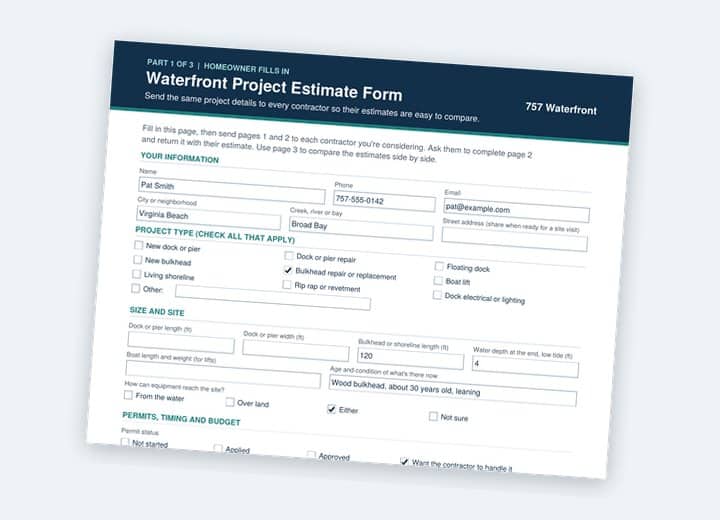
Three estimates rarely quote the same job. Our free printable form gets every contractor to answer the same questions, including license, insurance, permits, price and warranty, so you can compare them side by side.
Find a contractor
By type of work: Living shorelines · Rip rap and shoreline · Bulkheads and seawalls
By area: See contractors by city · Eastern Shore
This guide is general information, not legal or engineering advice. Permit rules and cost share programs change, so confirm with VMRC, your local wetlands board or the program before starting work. Sources: Code of Virginia § 28.2-104.1 and § 28.2-1302; VMRC, memo to local wetlands boards on 2020 living shoreline legislation (SB 776); Wetlands Watch, Designing Living Shorelines for Sea Level Rise in Virginia (Virginia CZM Program); Virginia Tech, Mapping how hurricanes could affect the Chesapeake Bay as sea levels rise (Oct 2026); Chesapeake Bay Foundation, Six Steps to Create Your Living Shoreline in Virginia; City of Hampton, Create a Living Shoreline; City of Norfolk, Virginia Conservation Assistance Program; Middle Peninsula Planning District Commission, Living Shoreline Incentive Program and Fight the Flood VA (living shoreline and grants and loans pages); VMRC Habitat Management Division, permitting (September 2025 change to online filing); Eastern Shore Soil and Water Conservation District, VCAP; The Nature Conservancy, Coastal Resilience: Living Shorelines for Virginia’s Eastern Shore. Last reviewed October 2026.