Contractor licenses
Read the license badge, then check it yourself
Every contractor on 757 Waterfront with a confirmed license shows it at the bottom of their listing: the license number, its class, and what it covers. Here’s how to read that line, and how to check any contractor yourself in about five minutes.
Which licenses cover docks, piers and bulkheads?
Virginia’s contractor board (DPOR) defines marine work as building, repairing or removing any structure that gives access to, holds back, or changes a body of water. That covers docks, piers, bulkheads, boat ramps and similar work. Three kinds of license allow it:
- Marine Facility (MCC): a specialty license for marine work.
- Commercial Building (CBC): a broad license that the state says also covers marine work.
- Highway/Heavy (H/H): a heavy-construction license (pile driving, excavation, foundations) that also covers marine work.
All three are equally valid for marine work under state rules. You don’t need to look for MCC specifically. On our site, contractors holding any of the three show the badge “VA licensed for marine work,” and the exact license is listed at the bottom of their description.
Other licenses, such as Residential Building (RBC), cover work on homes “including accessory buildings or structures on such property.” The state’s definitions don’t say whether a pier or dock at a home counts as one of those accessory structures, so a Residential Building contractor may well be properly licensed for that work. Contractors with these licenses show the badge “VA licensed contractor.” If it matters for your project, ask the contractor how their license applies, or contact DPOR.
No badge? That means we haven’t confirmed a license yet. It doesn’t mean the company is unlicensed. Some are licensed under a different name or in another state. Ask the contractor for their Virginia license number and look it up.
Dock and boat lift wiring is different: it’s electrical work, so look for an Electrical (ELE) license. These contractors show the badge “VA licensed electrician.”
What do Class A, B and C mean?
The class is about the size of jobs a contractor may take on, not quality or experience.
- Class C: single jobs under $30,000
- Class B: single jobs under $150,000
- Class A: no limit
Most residential docks, lifts and bulkheads fall within a Class B limit. For a large project, make sure the contractor’s class covers your contract amount.
A license isn’t the whole story
A license shows what a company is allowed to do, not how good it is. Some of the area’s longest-running marine builders hold a Commercial Building license rather than the MCC specialty, and some companies with MCC are brand new. Use the license as a baseline, then ask about experience, references, insurance, and recent jobs like yours.
Why would two good contractors hold different licenses? Usually it reflects the rest of their business:
- Who they work for. A Residential Building license covers homes only. Companies that also build marinas, community piers, or public bulkheads need a license that covers commercial or public work.
- How they started. A builder who added piers later often keeps the license they already had, while a company that began as a marine builder usually gets the Marine Facility specialty from day one.
- Heavier work. Companies that also do pile driving, dredging, or sitework often hold Highway/Heavy, which covers marine work too.
That’s why we show each contractor’s license as the state lists it, rather than ranking them by it.
How to check a license yourself
This is the same process I use for every listing on the site. It takes about five minutes.
- Start with DPOR. Go to the DPOR License Lookup and search by the license number on the listing, or by the company name. Try it with and without “LLC” or “Inc,” and with “&” spelled out as “and.”
- Nothing found? Look up the business with the SCC. Many contractors are licensed under a different legal name than the one on their truck. Search the company name in the Virginia State Corporation Commission’s business entity search. The record shows the registered agent, the principal office address and whether the business is active.
- Search DPOR again with what you found. Try the owner’s or registered agent’s name and any other company at the same address. That’s often where the license turns up. When we find it this way, our listing says “Licensed as…” with that name.
- Read the license. Make sure it’s active and the expiration date hasn’t passed. Look at the class (A, B or C, which limits the size of job) and the specialties (Marine Facility, Highway/Heavy and similar cover marine work). Check for any complaint history.
- Still can’t find it? Ask. A licensed contractor will give you the number without hesitation. If they won’t, that tells you something.
- Match it to your contract. The company name on your contract should match the name on the license.
One more thing the SCC search can show you: a business marked inactive. That’s often just a missed registration fee, but it’s worth asking about before you sign.
Licenses expire and renew, so the “Checked” date on each listing tells you when we last looked. We re-check periodically, but the state’s record is always the final word.
Free tool
Getting estimates?
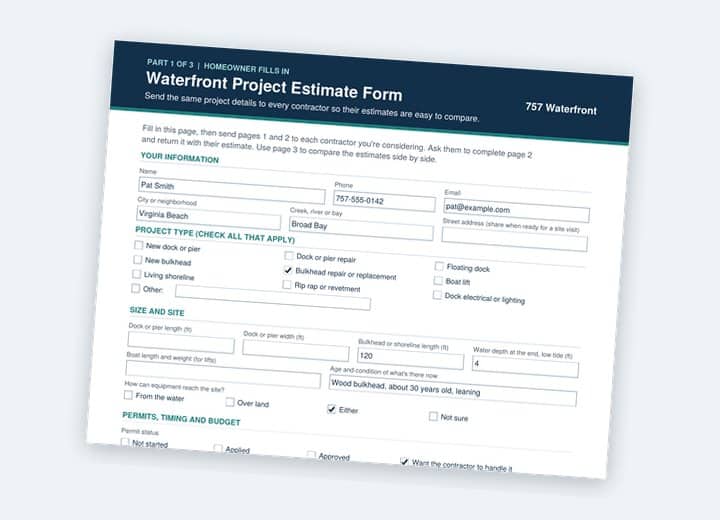
Three estimates rarely quote the same job. Our free printable form gets every contractor to answer the same questions, including license, insurance, permits, price and warranty, so you can compare them side by side.
Find a contractor
By type of work: Docks and piers · Bulkheads and seawalls · Boat lifts · Dock electrical
By area: See contractors by city · Eastern Shore
This page is general information, not legal advice. Sources: Code of Virginia § 54.1-1100 and Virginia Board for Contractors Regulations, 18VAC50-22.