Waterfront permits
One application starts the whole process
Almost any work along the water in Virginia, whether a new pier, a bulkhead replacement or a boat lift, needs some form of approval. The good news: one application usually starts the whole process, and most marine contractors handle it for you.
Updated October 2026. General information to help you plan, not legal advice. Rules change and every property is different, so confirm with your contractor and the agencies involved.
The short answer
Most waterfront projects begin with a single Joint Permit Application (JPA). Since September 1, 2025, it’s filed online through the U.S. Army Corps of Engineers’ Regulatory Request System, which shares it with the Virginia Marine Resources Commission (VMRC), Virginia DEQ and your local wetlands board. (Before that date, applications went to VMRC first.) Each agency reviews the parts of the project in its own jurisdiction, at the same time, and issues its own decision. Most marine contractors file it for you.
Who may review your project
| Agency | What it looks at |
|---|---|
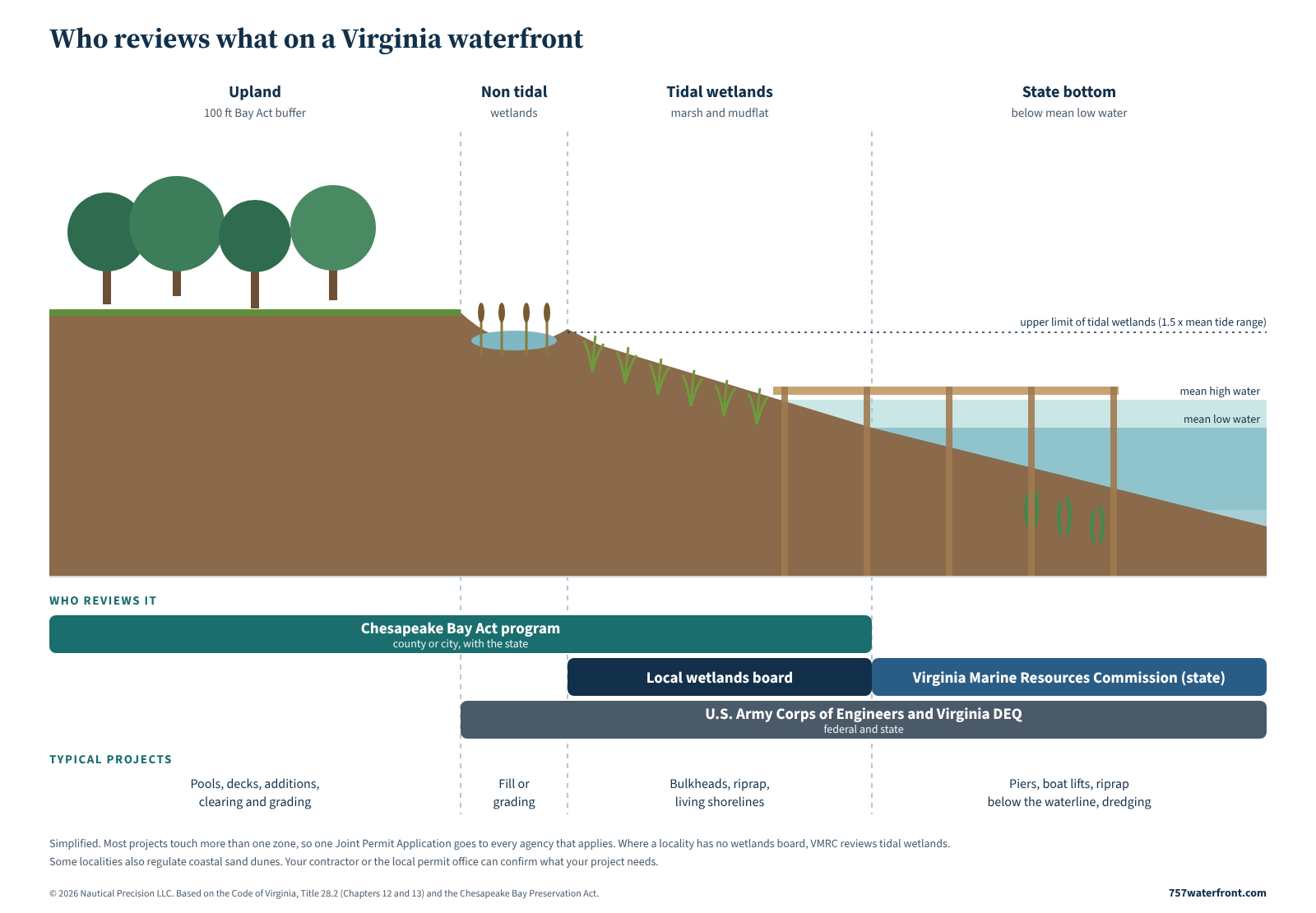
| Virginia Marine Resources Commission (VMRC) | Work on state-owned bottomland, below mean low water |
| Your city or county wetlands board | Tidal wetlands, beaches and dunes along your shoreline |
| U.S. Army Corps of Engineers | Work in navigable waters, which covers most waterfront property |
| Virginia DEQ | Water quality and non-tidal wetlands |
| Your city or county (Chesapeake Bay Act) | Land-disturbing work near the shoreline, in Resource Protection Areas |
The Bay Act review is separate from the Joint Permit Application. It covers the land side of your project, in the vegetated buffer that runs at least 100 feet up from the water. See what the Bay Act buffer means for your project.
Private piers: a simpler path
Virginia law lets waterfront owners build a private, noncommercial pier after an application to VMRC for review, without the full permit process, if the pier is no more than 6 feet wide (finger piers 5 feet), any T-head, L-head and floating platforms total no more than 400 square feet, and it doesn’t extend past the navigation line. A boat lift may be included, subject to local rules. Roofs over a single boat or lift larger than 700 square feet, gazebos over 400 square feet, or a neighbor’s objection to a roof mean a full permit. Other agencies, such as the Army Corps, may still need to approve.
Bulkheads and living shorelines
Since 2020, Virginia law has made living shorelines (marsh plantings, sand and stone sills) the preferred way to protect tidal shorelines wherever they’re suitable. Every application must explain whether a living shoreline would work at your site, and if it won’t, include living shoreline elements where possible. A bulkhead is still allowed where it’s the right answer, but expect this question to come up.
What the process usually involves
- Drawings. A site plan and cross-section showing the work, your property lines, neighbors, and the mean high and low water lines.
- The JPA. Filed online with the drawings and a statement on living shorelines. Most projects in tidal water, including residential piers, bulkheads, boat lifts and living shorelines, use the Tidewater JPA form; the Standard JPA is used mainly for work in nontidal waters and wetlands.
- Your neighbors. The application includes your adjacent property owners, and they get a chance to comment. Missing neighbor information can hold an application up, so have their names and addresses ready.
- Notice and hearings. Many projects are advertised in the newspaper and heard by your local wetlands board. If a neighbor objects, or you disagree with the wetlands board’s decision and appeal it, the Marine Resources Commission itself can take up the case at one of its monthly public meetings.
- Fees. Local fees are set by each city or county. In Virginia Beach, for example, wetlands permits are $450 and waterfront construction applications are $230. If your project needs a VMRC permit to use state owned bottomland, state law adds a $100 processing fee plus a permit fee of $100, or $300 for projects costing more than $10,000 ($600 above $500,000).
- Approval, then construction. Each agency issues its own approval; work starts once all are in hand.
Before you start
- Check your deed. Your property must actually touch the water to carry the right to build a pier, and those rights can be held back in a past sale.
- Know what’s already there. You can be responsible for an existing structure that was built without a permit, even by a previous owner.
- Ask your contractor. Most marine contractors prepare and file the JPA as part of the job. Ask whether the drawings, filing and fees are included in the price.
Already filed? See what happens after you apply: what reviewers look for, common conditions and realistic timelines.
Free tool
Getting estimates?
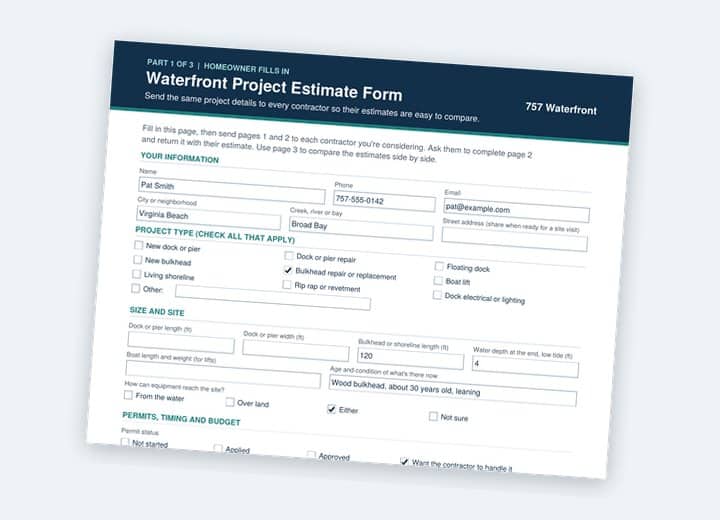
Three estimates rarely quote the same job. Our free printable form gets every contractor to answer the same questions, including license, insurance, permits, price and warranty, so you can compare them side by side.
Sources
- Virginia Institute of Marine Science: shoreline permit information
- VMRC Habitat Management Division: permitting and the September 2025 change to online filing
- Standard Joint Permit Application instructions (which form to use, adjacent owners, drawings)
- VMRC Commission agenda, September 2021 (example of protested projects and wetlands board appeals before the Commission)
- Code of Virginia § 28.2-1206 (state fees)
- City of Virginia Beach Wetlands Board
- Code of Virginia § 28.2-1203 (private piers)
- Code of Virginia § 28.2-104.1 (living shorelines)
- Pender & Coward: How to Build a Pier in Virginia
757 Waterfront is a directory, not a contractor or law firm. This guide is general information for planning, not legal advice.