
Norfolk waterfront
Dock, bulkhead and boat lift contractors in Norfolk
Norfolk owners file about 71 waterfront permit applications a year in state records, and nearly half of them are on the Lafayette River and its creeks, such as Wayne Creek. Most of the rest are along the Eastern Branch of the Elizabeth River, Little Creek, Willoughby Bay and Lake Whitehurst. Piers and docks are the most common projects, and living shorelines now outnumber new bulkheads about two to one. The contractors below serve Norfolk. Contact them directly; there are no lead forms and no middleman.
Norfolk marine contractors

- 804-695-4963
- (757) 437-8690
- 757-319-3001
- (443) 624-8213
- 757-463-1735
- 757-512-8822


- (757) 982-8082
- 757-818-3378
757 Waterfront is a free directory, not a contractor. A listing isn’t an endorsement. Each listing shows the contractor’s Virginia license as the state lists it (what the badges mean); always check insurance and references before you hire. Permit figures are from Virginia Marine Resources Commission application records, 2023 to 2025.
Plan your project
Permits and planning in Norfolk
Most waterfront projects start with a Joint Permit Application, filed online through the Army Corps and shared with the state agencies and the city. Norfolk has its own Wetlands Board, which holds its hearing on the second Wednesday of the month at 1 p.m. in City Council Chambers on the 11th floor of City Hall, 810 Union Street. Applications are due about a month before the hearing, and incomplete applications are not accepted. The local wetlands permit fee is $495, which covers the required legal notice. Often it never gets that far: for piers, the city says staff can usually help owners adjust the plans so no local wetlands permit is needed. Call Environmental Services at (757) 664-4363 before you file; staff will make an informational site visit. The city estimates 30 to 60 days from a complete pier application to a building permit, longer if the pier crosses city property and needs an encroachment permit, which City Council must approve. See what happens after you apply.
If you are planning shoreline protection, expect the review to ask whether a living shoreline would work before a bulkhead is approved. Building or clearing in the 100 foot Chesapeake Bay Act buffer is reviewed by the city, and Norfolk is strict about trees: every tree and shrub in the buffer is protected, removing one takes a tree permit and replanting, and removing one without a permit doubles the replanting. Under the city’s guidance, nothing paved or built may come within 25 feet of the wetlands, additions and attached decks generally stay at least 50 feet back, and on most waterfront lots sheds, pools, patios and detached decks must stay outside the 100 foot buffer. A Bay Act review for a single family home costs $220, and work that can’t meet the rules needs a variance from the Board of Zoning Appeals ($270). Dunes along the Bay beaches in Ocean View and East Beach are protected too, so check with Environmental Services before you build a walkway or regrade on a dune. Building permits are still needed on top of these approvals.
Help paying for it: in Norfolk, the Elizabeth River Project offers cost share for living shorelines of 50 percent of the project, up to $10,000. The city also runs the state’s Virginia Conservation Assistance Program with the local soil and water conservation district, which pays most practices, living shorelines included, 80 percent of the cost; call (757) 823-4048. Apply before any work begins. For a free look at an erosion problem first, the state’s Shoreline Erosion Advisory Service will visit your property and recommend a fix. Most contractors handle the permit paperwork, so ask when you get an estimate.
The Bay Act buffer: what you can build →
Do I need a permit for a dock? →
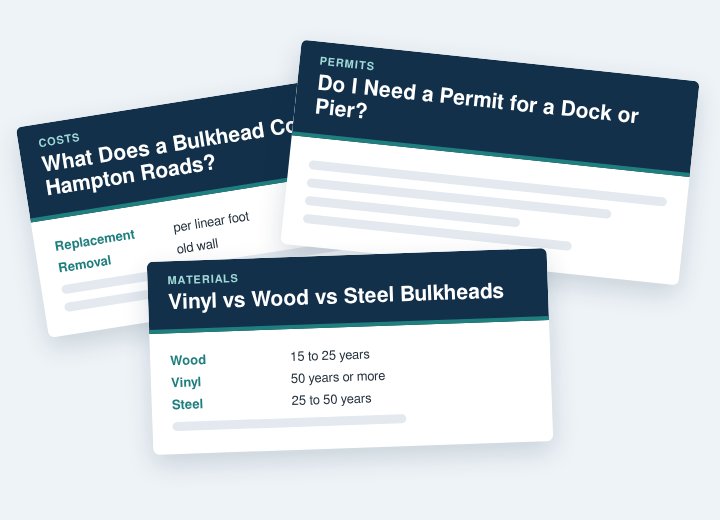
Bulkhead costs →
Dock and pier costs →
After a storm: what to check →
Free tool
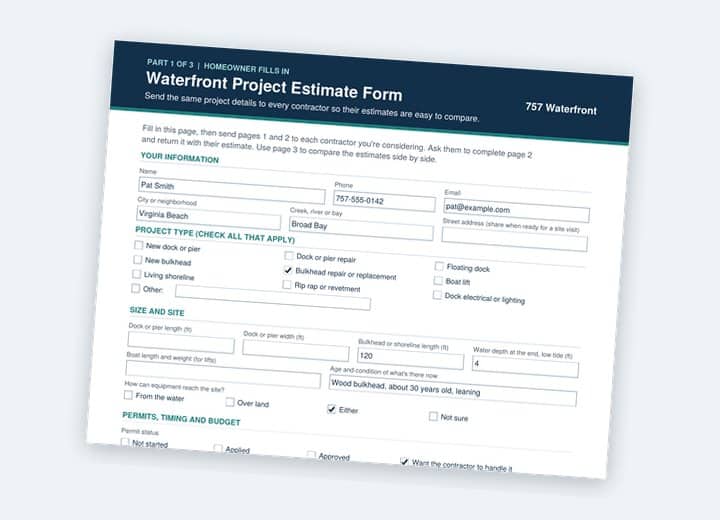
Getting estimates?
Three estimates rarely quote the same job. Our free printable form gets every contractor to answer the same questions, including license, insurance, permits, price and warranty, so you can compare them side by side.