
Waterfront permits
After you apply: how waterfront permits get reviewed
Filing the application is only the first step. After that, people you will probably never meet look closely at your drawings, ask questions, and decide what conditions come with your permit. This guide explains what they look for and what to expect, based on 2026 public review records from the Virginia Beach and Gloucester County wetlands boards and the official application forms.
If you have not started yet, read where to start with waterfront permits first. This guide picks up after the application is filed.
1. Where the work sits decides who reviews it
The same project can need one approval or three, depending on exactly where it is built:
- Out past the low tide line: that bottom belongs to the state, so the Virginia Marine Resources Commission (VMRC) reviews it.
- Between low and high tide, including marsh: your local wetlands board reviews it.
- In navigable water: the U.S. Army Corps of Engineers reviews it, and many residential projects fit one of its general permits.
A repair built entirely on the land side of an existing bulkhead may need only the local wetlands board. In one 2026 Gloucester case, VMRC told the applicant that a stone repair behind the bulkhead did not need a state permit as drawn, but did need the county wetlands board permit.
2. Repairs need permits too
Rebuilding a failing riprap slope, adding stone to rock that has settled, or replacing an old bulkhead all go through the same application as new work. Many of the 2026 cases we reviewed were repairs, not new construction.
3. Expect to explain why not a living shoreline
Virginia law makes a living shoreline the first choice for tidal shorelines when the site allows, and the application form says so. It asks what alternatives you considered and why you chose your design. It also asks for any report from the state’s free Shoreline Erosion Advisory Service or the Virginia Institute of Marine Science, so a free site visit up front can help your application later.
When a bulkhead or riprap was approved instead, the reasons reviewers accepted were usually one or more of these:
- A tall existing bulkhead that a gentle slope cannot tie into
- A long stretch of open water in front of the property, strong waves or heavy boat wake
- Neighboring shorelines that are already hardened
- Not enough room to grade a gentle slope. Staff accepted this where a house sat about 22 feet from the bulkhead and where a pool or pool deck sat about 17 to 18 feet away.
- A steep bank, or heavy shade from trees that would keep marsh grass from growing
- A narrow canal or a nearby dredged channel, since a marsh sill can stick out 12 to 15 feet from the bank
4. The usual order of preference
Reviewers generally prefer a living shoreline, then riprap, then a bulkhead, because each step down offers less habitat. Virginia Beach staff wrote in 2026 that riprap “is preferred over a bulkhead because it provides habitat.” That is not absolute. In some cases a bulkhead was approved because riprap would have covered more existing marsh.
- A common fix for a failing bulkhead is to place riprap in front of it, or sometimes behind it, instead of tearing it out.
- Replacing a bulkhead? The application asks whether the new wall will sit no more than two feet out from the old one. Going farther out needs a written reason, and reviewers often push to keep it in line with the old wall.
5. The fast track for living shorelines has limits
Qualifying living shorelines can use a state general permit, which is simpler than a full review. In 2026 Virginia Beach records, two projects missed it: one faced 2.1 miles of open water, more than the 1.5 mile limit, and the other needed a stone sill more than one foot above high tide to handle waves and boat wake. Both were still approved after full wetlands board review. Ask your designer early whether your project qualifies.
6. Expect questions and revisions
Follow up questions are normal, and several 2026 applications were revised once or twice. Reviewers asked for things like:
- Two fixed reference points, such as corners of the house, with measurements to each end of the new structure, so its location can be checked after it is built. A single unlabeled point was not accepted.
- Cross sections showing the width of the old and new work
- The class of stone being used
- Confirmation that the work will not extend farther out toward the water
- A note on the drawings about anything not included, such as an existing pier
Clear, complete drawings are one of the best reasons to hire someone who files these regularly.
7. Conditions you may see on your permit
- Wetland mitigation credits: if your project covers wetland, you will usually be required to buy credits from an approved mitigation bank. State code prefers this over building replacement marsh on your own lot.
- Tree protection and replacement: fencing outside the drip line of trees being saved, and replanting for trees removed, up to three trees for each one damaged in the Chesapeake Bay Act buffer.
- A buffer replanting plan when fill or clearing touches the Bay Act buffer.
- An encroachment agreement with the city when work crosses onto city property, required before the permit is released.
- Plant monitoring: one Virginia Beach project with coir logs and new marsh plants must send a report with photos every August for three years.
- Local permits: such as a site plan review or a hauling permit, in addition to the wetlands permit.
8. Hearing day and the weeks after
Using the Virginia Beach Wetlands Board as an example:
- Staff brief the board in the morning, then the public hearing begins. The applicant or agent gets 10 minutes, supporters get 3 minutes each, an opposition spokesperson gets 10 minutes, and the applicant gets 3 minutes for rebuttal.
- Most applications reach the hearing with a staff recommendation to approve, often with conditions.
- If you ask to postpone, the board defers for at least 60 days.
- Decisions can be appealed to VMRC within 10 days, so no permit is issued before then.
- Within about 14 days you should get a letter listing fees owed, any required revisions and your next steps.
Every locality runs its own schedule. Gloucester, for example, wants applications about six to seven weeks before its monthly hearing. Check your city page for local details.
9. Plan on months, not weeks
In the 2026 records, drawings sealed in late June reached VMRC in mid July and were heard in late September. Some projects appeared on two or three monthly agendas before they were decided, after deferrals or redesigns. Build that time into your plans, especially before hurricane season or a home sale.
10. Who files for you
- Your contractor can act as your agent. This was common in Gloucester County.
- A permit firm or consultant can handle the application while a separate contractor builds. Most Virginia Beach filings in 2026 came through a few permit firms.
- You can file it yourself. Several 2026 Gloucester applications were filed by homeowners with no agent.
Whoever files, you sign as the applicant, so read the drawings before they go in.
Build it exactly as approved
If the finished work does not match the approved plans, the board can call the homeowner, the agent and the contractor back for a hearing, even years after the permit was issued. Keep a copy of your approved plans, make sure your contractor builds to them, and ask whether an as built survey is planned. Before you hire, check the contractor’s license.
Free tool
Getting estimates?
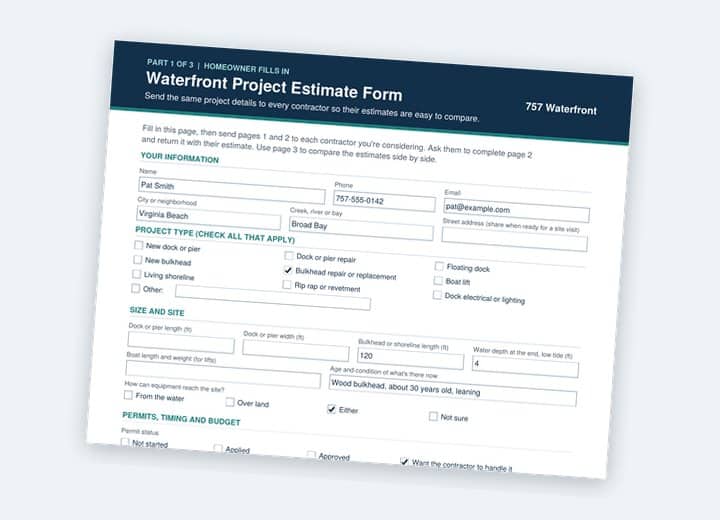
Three estimates rarely quote the same job. Our free printable form gets every contractor to answer the same questions, including license, insurance, permits, price and warranty, so you can compare them side by side.
Sources
- City of Virginia Beach Wetlands Board: public hearing procedures and staff reports, April through October 2026
- Gloucester County Environmental Programs and Wetlands Board: 2026 application records and hearing schedule
- Commonwealth of Virginia Joint Permit Application form, Appendix B: shoreline stabilization questions
- U.S. Army Corps of Engineers Regulatory Request System
- Code of Virginia § 28.2-104.1 (living shorelines)
- Code of Virginia § 28.2-1302 (wetlands zoning ordinance)
This guide is general information, not legal or engineering advice. It summarizes patterns in public records and does not describe any individual property. Rules and schedules vary by locality and change over time, so confirm with your local wetlands board, VMRC and the Corps before you start. Last reviewed October 2026.